


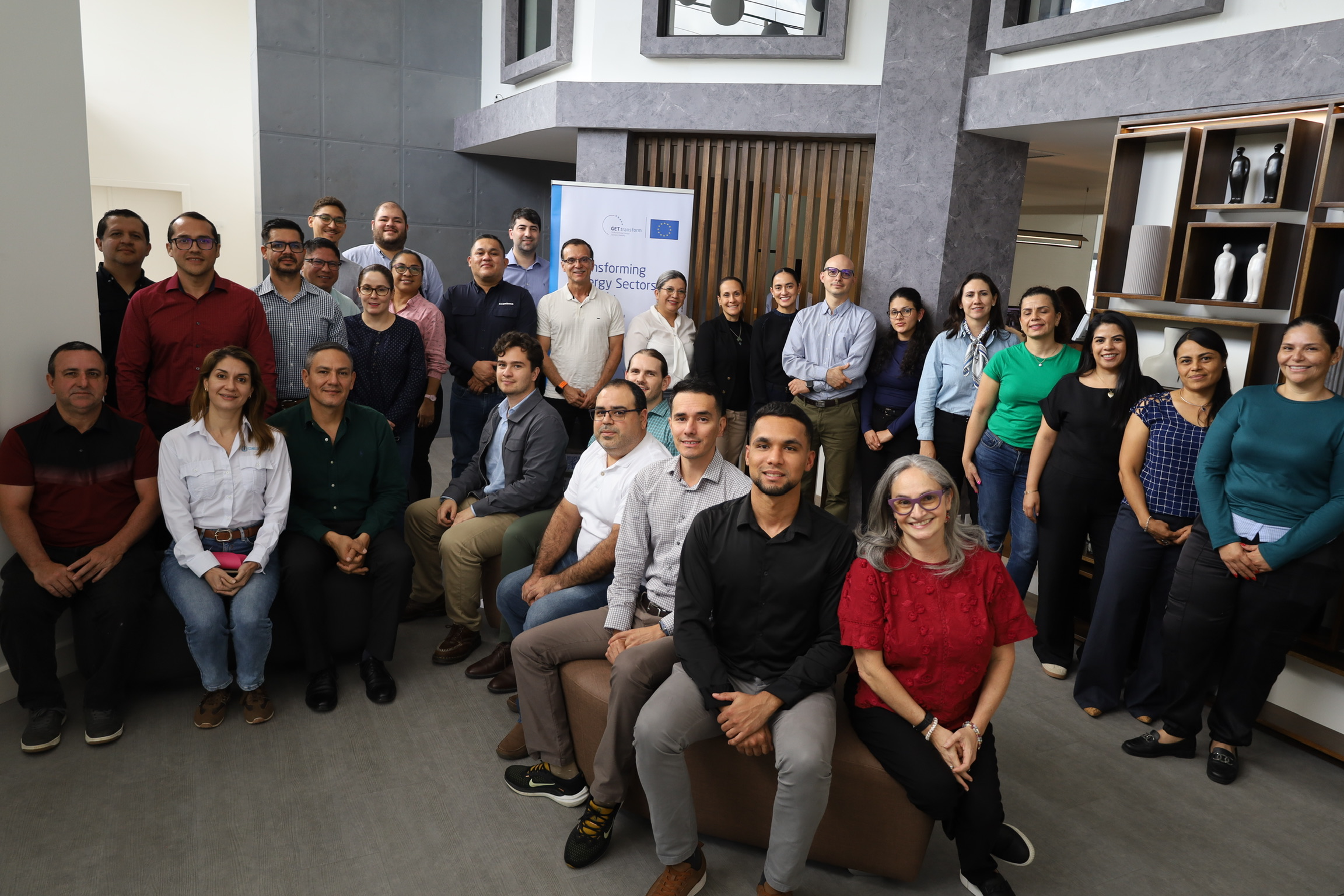
In Costa Rica, a three-day training in October on Efficient Tariff Design gathered leading energy sector regulators and policymakers from Panama and Costa Rica to equip them with the economic and regulatory frameworks needed to improve energy planning and design modern tariff structures. Participants broadened their knowledge of tariff structures based on lessons learned in other countries and learned how to avoid the risks that come with implementation.
30 representatives from a variety of organisations such as Autoridad Nacional de los Servicios Públicos (ASEP) and National Energy Secretariat (SNE) in Panama, as well as from Ministerio de Ambiente y Energía (MINAE), Autoridad Reguladora de los Servicios Públicos (ARESEP), Instituto Costarricense de Electricidad (ICE), Compañía Nacional de Fuerza y Luz (CNFL), Conelectricas and Coopelesca participated.
An intensive 18-hour course combined both theoretical principles and practical applications. The first day covered the principles of tariff regulation and efficient cost recovery, including economic fundamentals such as sufficiency, efficiency, equity and cost reflectivity, load characterisation, and the practical application of building a tariff baseline structure.
On the second day, time–of–use (ToU) tariffs, electric mobility, and efficiency signals were explained. Participants learned about energy transition challenges related to distributed generation integration and storage, advanced pricing mechanisms and electric vehicle (EV) charging structures for residential and public transport tariff models.
The last day of the course focused on modern tariffs for distributed generation, self-consumption, and vulnerable users. Risks regarding financial impacts of self-consumption on net revenues were discussed alongside compensation schemes such as net metering, net billing, and equity measures including targeted social tariffs.
Juan Pablo Marzocca led the training on behalf of GET.transform. The Lead Utility Business Modeling Expert of GME brings extensive regional experience in energy load characterisation, econometric modeling, and international tariff benchmarking.
By designing tariffs more efficiently, regulators can better satisfy the needs of both consumers and providers to encourage adoption, strengthen national electricity systems, and advance the energy transition across Latin America.
This course is the first of a three-part series centred on country and regional priorities for regulation, renewable energy, storage and tenders which were defined by interviews and workshops conducted through a consultancy. Interviewees included partners from Honduras, San Salvador, Guatemala, Costa Rica and Panama, regional electricity market stakeholders, in addition to Steering Committee of the Regional Electricity Market (CDMER), Regional Commission for Electrical Interconnection (CRIE) and Regional Grid Owner Company (EPR).
Another efficient tariff design training took place in Honduras on 26-28 October for participants from Guatemala, El Salvador and Honduras.
The second part of the training series will discuss storage, add-on services and flexibility models for Costa Rican and Panamanian representatives mid-November, and a few days later for stakeholders from Guatemala, El Salvador and Honduras.
The final training will cover tender preparation for transmission, generation and storage in Costa Rica and Honduras end of November.
