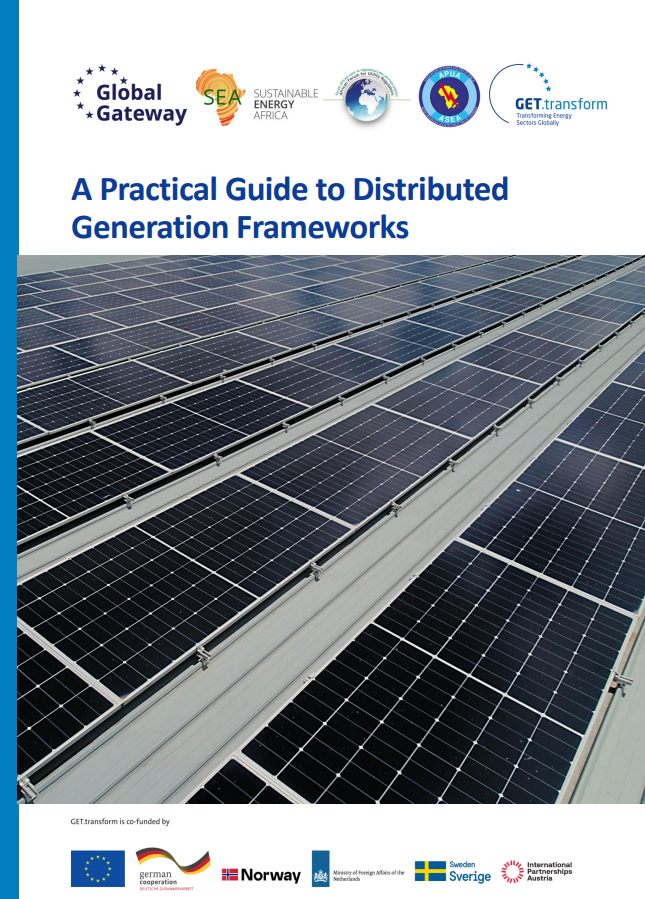


Distributed generation (DG) is rapidly transforming energy access across Africa, particularly within commercial and industrial sectors. As highlighted in A Practical Guide to Distributed Generation Frameworks, this growth, driven in part by a significant increase in solar PV deployment, presents both opportunities and challenges for power systems. While DG enables customers to reduce energy costs, improve reliability, and support economic growth, its unregulated expansion may bring technical complexities, disrupt grid operations and undermine utility revenues.
To address this, GET.transform with the support of Sustainable Energy Africa (SEA), and Energynautics, has developed a step-by-step guide that supports regulators and utilities in establishing robust frameworks for the safe, compliant, and financially sustainable integration of DG into existing networks. Reflecting on inputs shared by Policy Catalyst Distributed Generation Window for Regulators and Utilities , which is run by SEA and GET.transform in partnership with the African Forum of Utility Regulators (AFUR), the Association of Power Utilities of Africa (APUA), this guide outlines a strategic approach that responds to the unregulated challenges based on three core building blocks: regulatory and procedural, economic, and technical.
At its core, the publication introduces a “Trifecta” of regulatory building blocks. It first delves into the regulatory and procedural component which focuses on establishing clear frameworks aligned with national legislation. This includes mechanisms such as net metering or net billing regulations, alongside utility requirements and connection agreements that define application, approval and connection processes. These practical tools ensure transparency in the roles and responsibilities among regulators, utilities, and customers.
The economic component addresses the need for sustainable tariff design that balances utility sustainability with attractive conditions for DG customers. As more users shift to self-generation, traditional tariff structures may erode utility revenues, potentially leading to financial instability. The guide therefore underlines the importance of unbundled tariffs, cost-reflective pricing, and carefully calibrated export tariffs that uphold both investment incentives and utility viability.
Finally, the technical component acknowledges the efforts of maintaining grid stability and power quality. In the context of increasing DG penetration, issues like reverse power flows and voltage fluctuations can arise. Thus, this document proves the importance of simplified connection criteria and interconnection standards to enable safety in DG systems integration, avoiding the overly complex studies for smaller installations.
By combining policy guidance with hands-on tools and templates, this publication equips stakeholders with the resources needed to manage the growing adoption of distributed generation. Ultimately, it supports countries in harnessing DG as a driver of reliable, efficient, and sustainable energy systems.
Download the DG Regulatory Guide and delve into our related DG Impact Case Study.