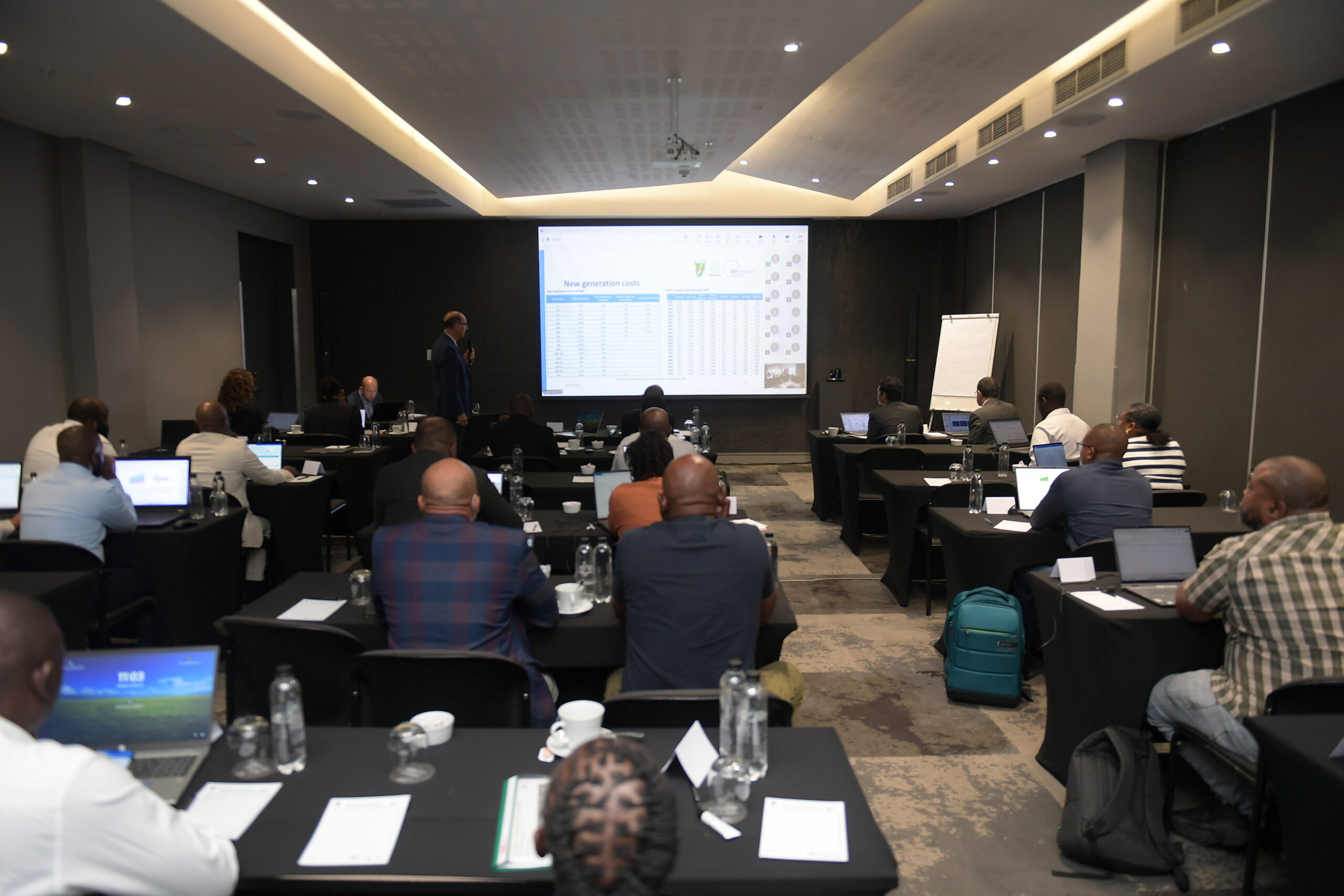


Late November, The Southern African Power Pool (SAPP) assembled a 5-day validation workshop in Johannesburg, South Africa, as part of the ongoing update of the SAPP Generation and Transmission Master Plan for the period of 2025-2045. The regional planning exercise focused on identifying priority investments, ensuring reliable and efficient electricity supply, enhancing cross-border power trade, and upholding alignment with continental initiatives such as the Continental Power Systems Master Plan and the African Single Electricity Market (AfSEM).
Work has been progressing across all major components of the Master Plan update with first milestones completed, including inception, data validation, model development, and initial scenario formation. The modelling currently focuses on three scenario packages: a Benchmark Scenario that provides the reference case for long-term planning, a Full Regional Integration Scenario that analyses the benefits of increased power trade and cooperation, as well as Renewable Energy Scenario that delves into accelerated deployment of clean energy in the region.
The Johannesburg workshop united representatives from the SAPP Coordination Centre, SAPP member utilities, the African Union Commission, the Southern African Development Community (SADC), GET. transform, and the consulting team. The update is being supported by GET.transform through the BMZ-funded ENGAGE programme which focuses on strengthening African energy infrastructure development. Participants discussed generation expansion pathways, system costs, cross-border trade flows, reliability outcomes, and indicative transmission needs, ensuring that analytical assumptions reflect both regional and national development priorities.
In parallel, SAPP and GET.transform delivered targeted capacity-building sessions to strengthen the technical skills of regional partners. These trainings highlighted scenario development and evaluation, uncertainty and sensitivity analysis, and the interpretation of modelling results to support informed and transparent decision-making on long-term system investments.
Insights from the workshop and training will now inform the final stages of the Master Plan update, including the identification of priority transmission corridors and generation investments, as well as preparation of an implementation roadmap for 2025-2045. The completed Master Plan will provide a coherent, forward-looking strategy for the region’s power sector, support climate-resilient infrastructure development, and contribute to an efficient and well-integrated electricity market across Southern Africa.